
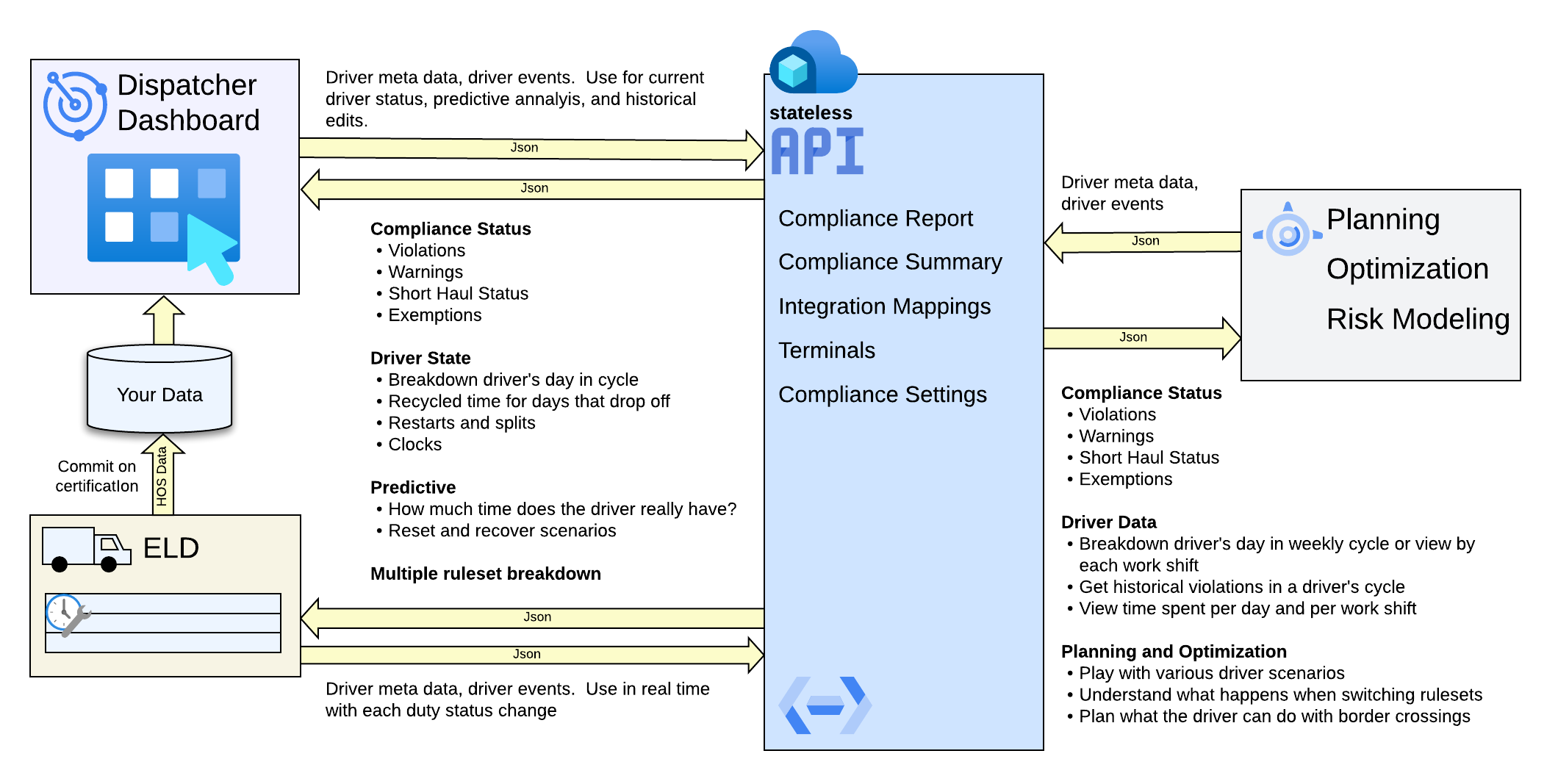
Your platform sends driver activity data to HOS Codex
You send driver meta data and driver events
HOS Codex evaluates compliance
Your platform receives structured results
It’s Your Data
HOS Codex does not store operational data, though terminals can be optionally saved to keep payloads smaller
Each request is independently evaluated
Your platform remains the system of record
No driver history persistence
No synchronization concerns
use the Values You Already Use
Integrate your own terminology
Inbound and outbound normalization
No forced enums or event codes
{
  "driver_id": "J73",
  "ruleset": "ruleset.us.interstate.property",
  "cycle": "cycle.us.60hours.7days",
  "iana_id": "America/Los_Angeles",
  "events": [
    {
      "timestamp_utc": "2025-05-30T20:00:00Z",
      "event_type": "DS",
      "duty_status": "D",
      "origin": "M"
    }
  ]
}
Example Request (overly simplified)
This is a minimal example showing a single change in duty status event.
Flexible Integration with Aliases
HOS Codex uses a standardized compliance model, but supports mapping for existing systems. If your system uses different values, you can define aliases for a number of things instead of changing your data.
Example of custom change in duty status value:
"event_type": {
      "duty_status_change": {
        "system_value": "DS",
        "alias": 4
      }
If your system uses an integer value of 4 to represent change in duty status events, you can map that event to your system using an alias. Once mapped, you can send 4 instead of "DS" and HOS Codex will interpret it correctly.
Mapping can be used for several different things and is applied consistently in both directions:
Inbound: Your values are translated into the HOS Codex canonical model for processing
Outbound: HOS Codex responses can return your mapped values instead of canonical codes
This allows your system to remain consistent end-to-end, without requiring changes to your internal representations.
What Comes Back
The response includes real-time compliance results along with the full regulatory context used to calculate them.
This includes:
Current compliance status
Remaining drive time and duty limits
Violation history and their associated rulesets
Short Haul status
Exemptions
Availability and rest scenarios
Includes a ruleset-based breakdown of driver activity, showing time allocated to each duty status per day and per shift
Organize data by days, work shifts, or both
Each response reflects the exact regulatory ruleset applied (e.g. US interstate property, 60-hour / 7-day cycle), ensuring calculations are traceable and consistent across systems.
Enterprise continuity options are available for customers requiring operational recovery and long-term platform assurances.